
The platform
NBFC software, from the lead to the closure letter.
Most lenders run an origination system, a servicing system and an accounting package, and spend the last week of every month reconciling them. Here the loan event posts to the books as it happens, so there is one set of facts.
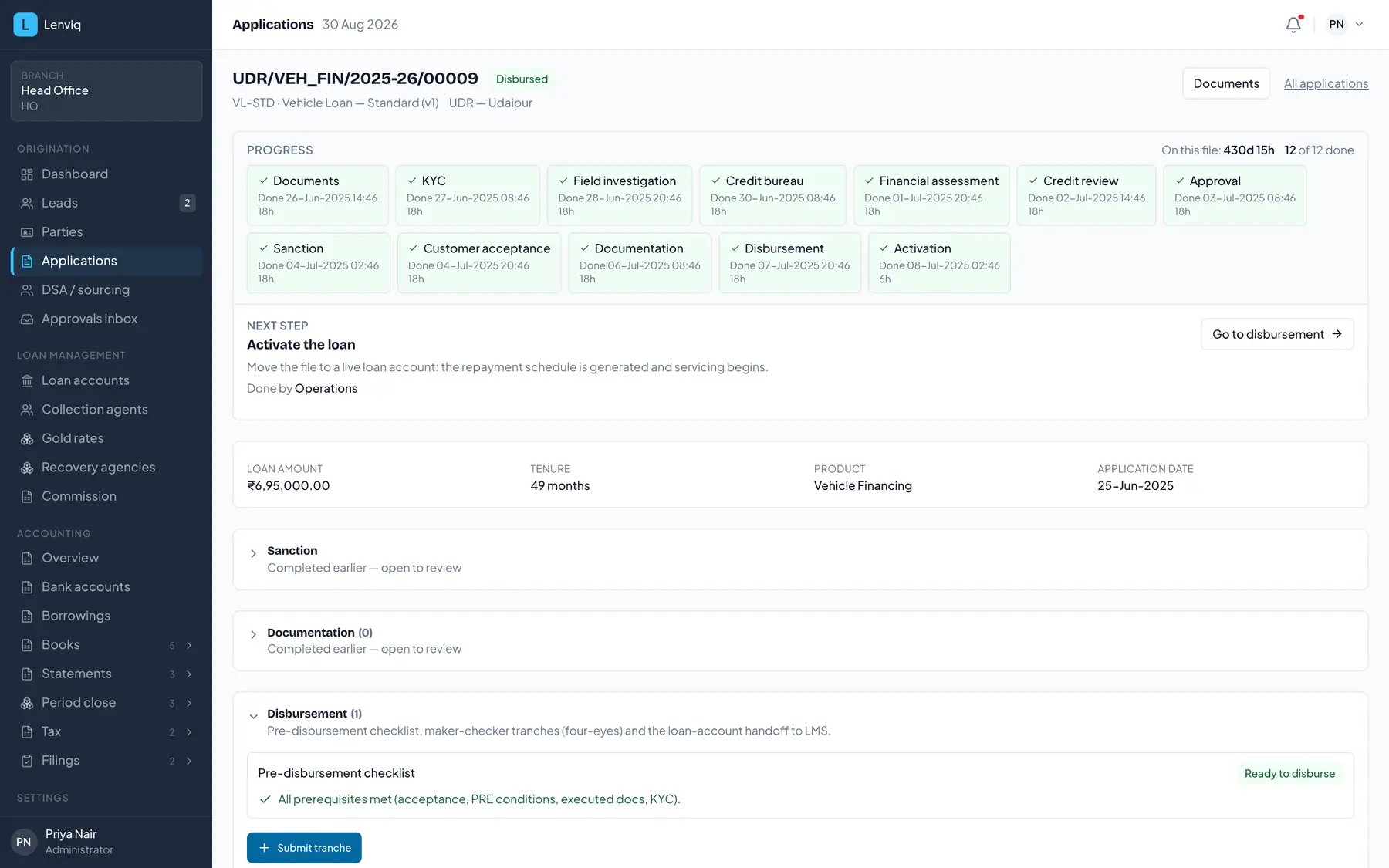
The lifecycle
What happens to a loan, in order
Eleven stages, one system. The point is not that each exists — it is that a loan carries its record forward through all of them, so the answer at the end can be traced to the event at the beginning.
01
Loan origination
A lead becomes an application, with the borrower, co-applicants and guarantors held as party records rather than as fields on a form — so a second loan starts from what is already known.
02
Credit and underwriting
Bureau pulls recorded against the file with the report attached, income and obligations assessed into a ratio whose workings are stored, and deviations that carry the approval level they require.
03
Approval
An approval matrix routes by sanctioned amount through its slabs. Master activation and disbursement are maker-checker: the person who prepares is never the person who releases.
04
Documentation
The sanction and disbursement pack generated from the loan’s own terms — application, agreement for the asset class, Key Facts Statement, promissory note, mandate — on your letterhead, with the borrower declaration in fourteen languages.
05
Disbursement
Released against the sanctioned terms, with the funding instrument recorded and the accounting entry posted as it happens rather than at month end.
06
Loan servicing
Schedules, receipts, part payment and foreclosure. Seven repayment shapes, because a gold loan and a twenty-year property loan do not repay alike.
07
Interest and charges
Interest accrued nightly on the balance outstanding that day. Charges levied under their own rules — penal amounts as charges rather than interest, never compounded and never added to principal.
08
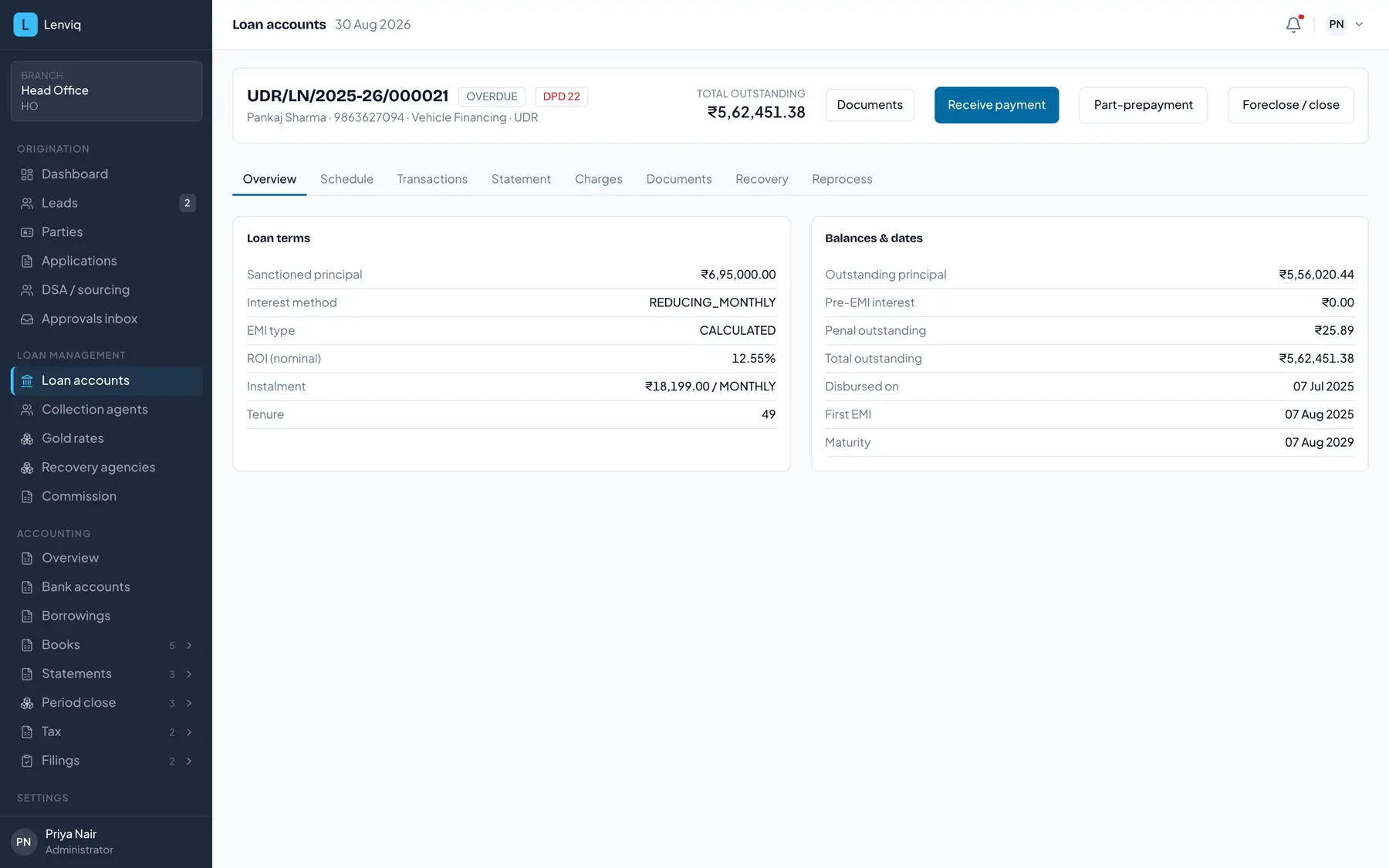
Collections
Allocation, follow-up and field collection on a phone that works without a signal, with a receipt that cannot post twice if the network retries.
09
Accounting
Double-entry vouchers generated from the loan events themselves, into a chart of accounts a Tally-trained accountant recognises. GST on fees, TDS against certificates, statements that foot.
10
Compliance and reporting
Day-end IRAC classification, SMA buckets, provisioning and income reversal on NPA — then the returns and the operational MIS that follow from them, each naming the date it is as at.
11
Audit trail
Every mutation writes who, when, and the before and after. Sanction, disbursement and rejection are immutable events; a correction is a reversing entry, never an edit. This is the stage that makes the other ten defensible.
Origination
Lead to disbursement
- Leads and applications
- Capture, assignment and a stage-by-stage workflow to sanction, with turnaround visible per stage.
- Parties
- Individual and non-individual borrowers, co-applicants and guarantors, with the KYC each constitution actually requires.
- Collateral
- Property and gold today, each valued and tracked under its own rules — gold by purity and net weight, property by valuation and charge.
- Credit
- Bureau pulls recorded against the application with the report attached, scoring bands, and approval slabs that route by amount.
- Sanction and disbursement
- Sanction snapshots the scheme's terms, so a later change to the scheme cannot alter a loan already sanctioned. Disbursement is maker-checker.
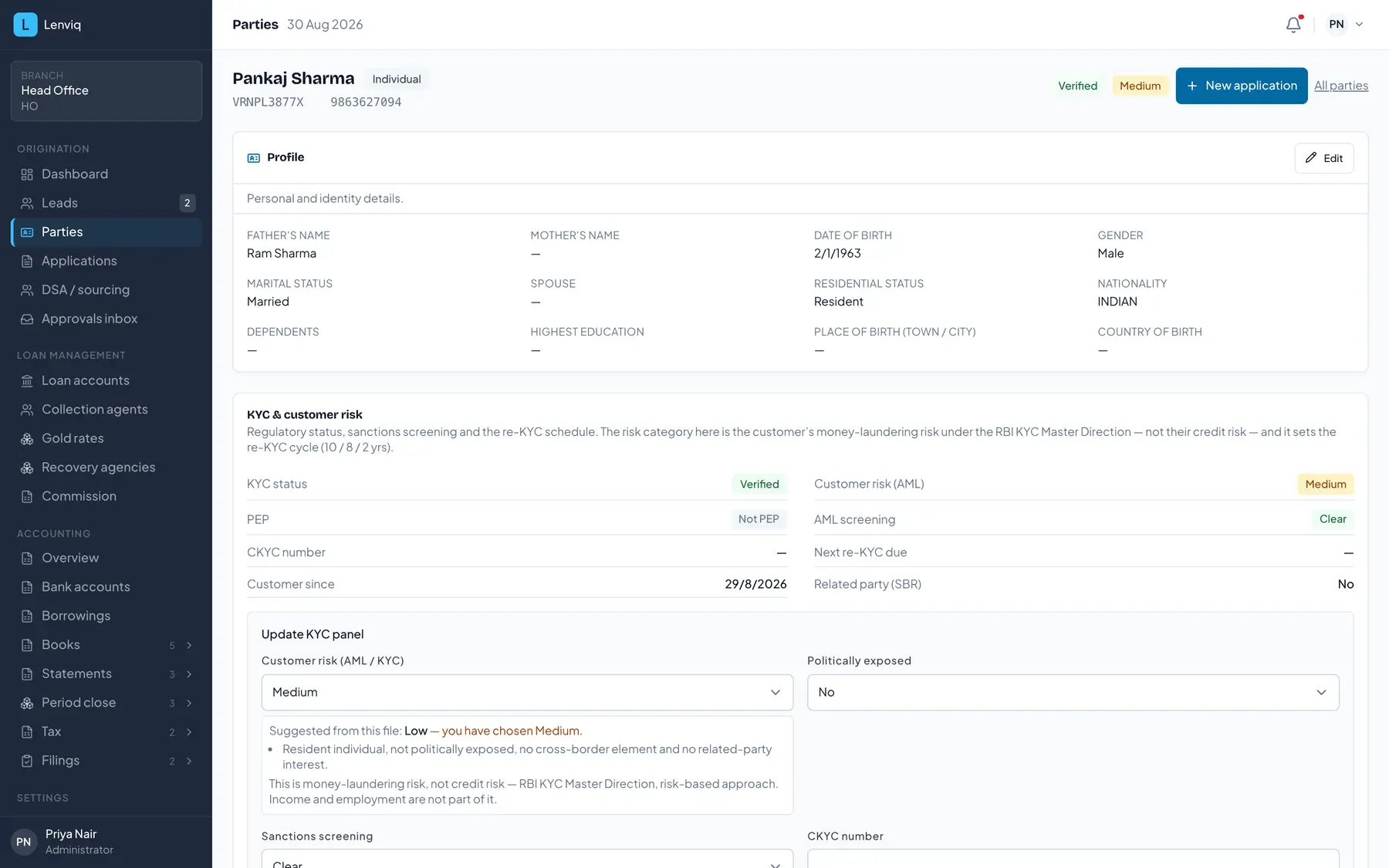
Loan management
Disbursement to closure
- Servicing
- Schedules, repayments, receipts, part payment and foreclosure, with the statutory bar on pre-payment charges applied by the system rather than by the scheme.
- Collections
- Allocation, follow-up, and collection efficiency measured the way a lender's diligence pack asks for it.
- Asset quality
- DPD, SMA buckets, IRAC classification and provisioning, computed at day-end in a scheduled job.
- Gold
- Purity, LTV against the day's rate, renewal pipeline and auction tracking.
- Borrowings
- The liability side: facilities, drawdowns, drawing power from the day-end statement, and the security pool pledged against each.
In the field
The round, on the phone that is already in their pocket
Collections, lead capture and field investigation, built for a hand and a street — and for no signal, which on a round is normal rather than exceptional.
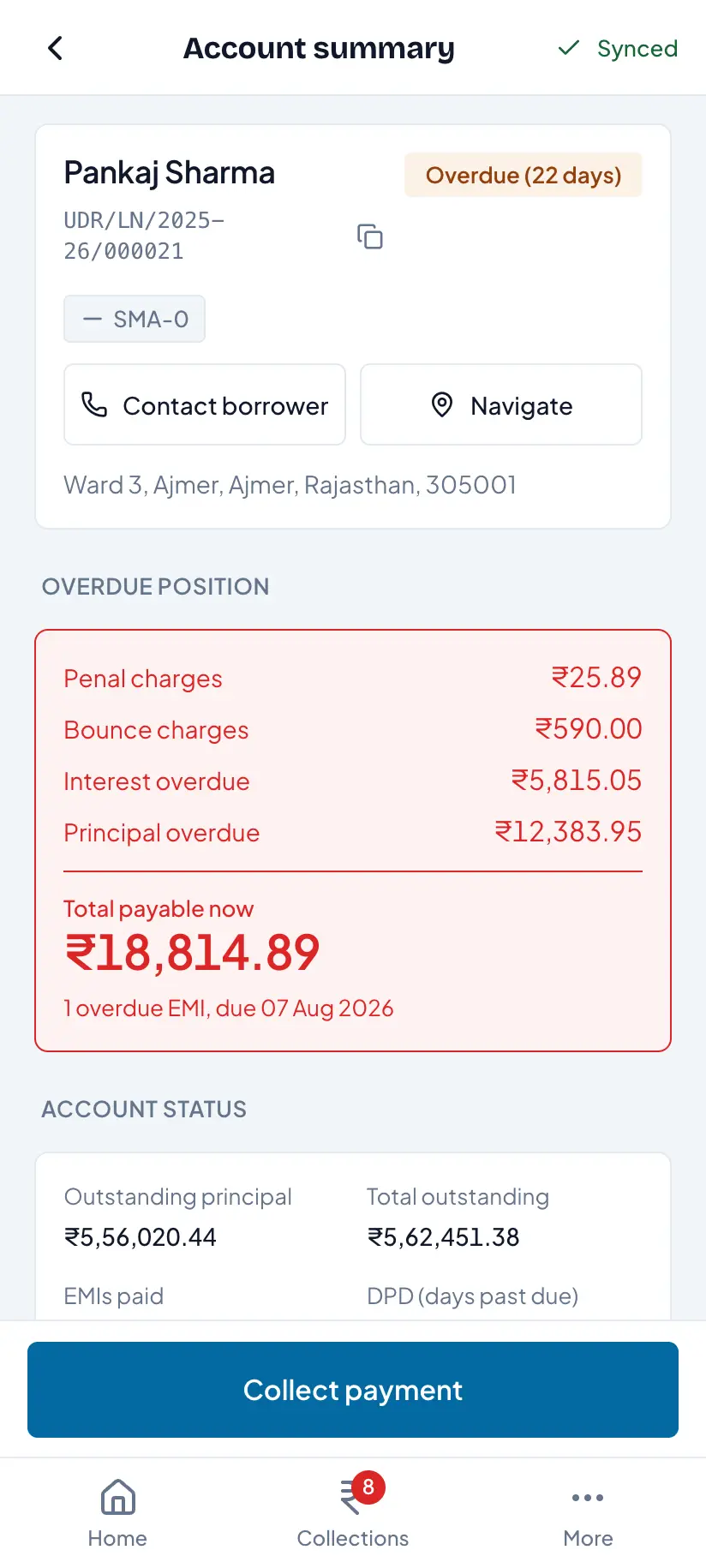
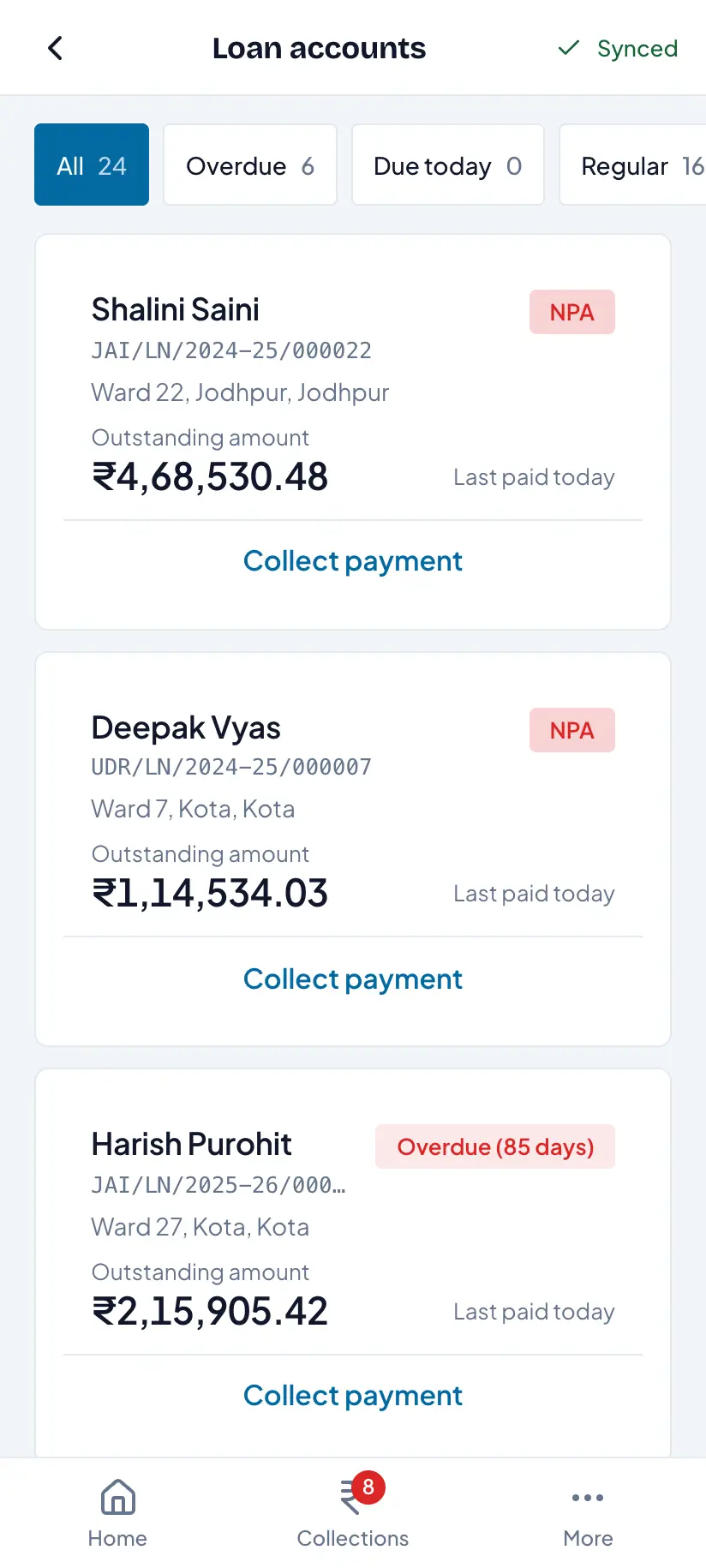
Every screen here works with no network. A collection is held on the phone with its photograph and its location and sent when a tower appears — and the receipt is idempotent, so a retry cannot post a second payment against a borrower’s loan.
Accounting
Double entry, not a summary
A chart of accounts a Tally-trained accountant recognises, postings generated from the loan events themselves, and statements that foot.
Chart of accounts
GST and TDS
Statements
By loan product
Four books, one system
Asset-class behaviour is configuration, not four code paths — but what each book actually demands of the software is different enough to be worth setting out on its own.
Implementation
What a pilot actually looks like
Reducing perceived risk moves more decisions in this market than another feature does, so here is the shape of it rather than a promise about it.
1 · Pilot
2 · Migration
3 · Run
Timelines depend on the state of the data you are migrating from, which is the honest answer — we would rather scope that with you than publish a number that turns out to be somebody else’s.
The fastest way to judge fit is to see it against your own product mix.
Request a demoQuestions
What lenders ask before a shortlist
- What is NBFC software, and how is it different from a loan management system?
- A loan management system services a loan that already exists — schedules, receipts, interest, classification. NBFC software is the whole lifecycle around it: origination before the loan exists, the accounting under it, and the returns that come out of it. Buying only the servicing half leaves the origination in spreadsheets and the ledger in a second system, which is where most reconciliation work comes from.
- Which loan products does it run?
- Gold, property, personal, business and vehicle loans, and overdraft and cash credit limits. Each one binds by its behaviour rather than its name, so a scheme is configured rather than coded — a gold loan is priced by an approved daily rate and a purity-adjusted weight, a cash credit accrues daily on the drawn balance against a drawing power, and both post to their own ledgers.
- Does it do the accounting, or does that stay in Tally?
- It does the accounting. Loan events generate double-entry vouchers into a chart of accounts a Tally-trained accountant recognises, with GST on fees, and TDS receivable tracked quarter-wise against the certificate and 26AS status. A trial balance that foots is the point: a lending system whose figures have to be re-keyed into a ledger has moved the reconciliation rather than removed it.
- How are NPA and provisioning handled?
- Classification is computed in the day-end batch, never on request, so a report at 11am and one at 6pm describe the same day. Provisioning follows the NBFC rates rather than the bank ones — 10% on a sub-standard asset, and a doubtful exposure split with the secured portion at 20, 30 or 50% by age and the rest at 100% — and the standard-asset rate follows the tenant's layer.
- Can it be configured, or does every lender get the same rules?
- The commercial choices are configurable: rate bands, charge amounts, penal grace, approval slabs, repayment shapes. The regulatory positions are not. An SMA boundary or a ninety-day trigger a tenant could move is a setting that produces a wrong return.
- What does it take to go live?
- A chart of accounts, opening balances as at a migration date, the schemes you lend under, and your branches and users. The book is entered at a stated date and everything after it is generated by the system rather than typed, which is what makes the audit trail worth having.