The lending system that can show its working.
Origination, servicing, accounting and RBI reporting in one system. Every posting is double-entry, the arithmetic does not drift, and every change records who made it and what it was before — so when a figure is questioned, the answer is in the system rather than in somebody’s memory.
Portfolio ageing
as at day-endIllustrative figures. Lenviq computes DPD and IRAC classification from the day-end position, not intra-day.
Who it is for
Built for India’s NBFCs, and the people who keep them compliant
Lenviq is built around the rules an NBFC is examined against — the Master Directions, IRAC classification from the day-end position, the penal-charges regime, the returns. In general-purpose lending software those are things you configure and then defend; here they are the product itself, which is why the compliance work is specific rather than something you assemble.
The platform
From loan file to final accounts, in one system
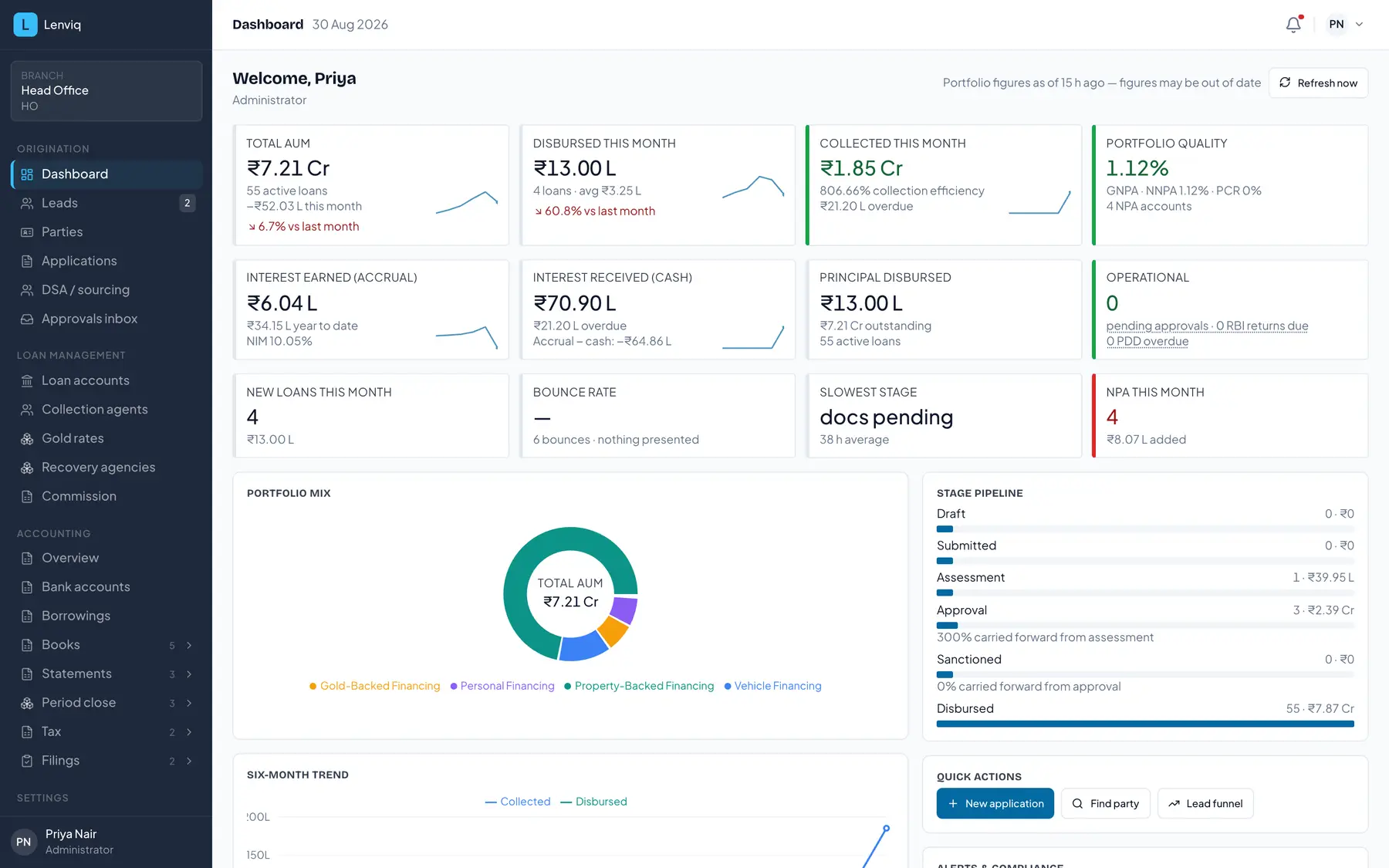
Every loan event posts to the books as it happens, so the portfolio and the accounts are the same set of facts rather than two systems reconciled monthly.
Origination
Loan management
Accounting
Documents
Compliance
The regulatory positions, implemented and citable
Most lending software treats compliance as a reporting layer bolted on at the end. Here it is in the engine: the classification, the charge treatment and the disclosure are computed where the money is, not assembled at quarter-end.
Key Facts Statement
Penal charges
IRAC classification
Reports
The reports a lender is asked for, not a chart builder
Portfolio, collections, asset quality, gold and operations — each report answering one question, naming the date its figures are as at, exportable, and masking personal identifiers by default.
Documents
The pack, generated from the loan
Sanction letter, agreement, Key Facts Statement, repayment schedule, NACH mandate, statements and certificates — assembled from the loan's own terms, on the lender's letterhead.
The borrower declaration is produced in fourteen languages — Hindi, Bengali, Marathi, Telugu, Tamil, Gujarati, Kannada, Malayalam, Odia, Punjabi, Assamese, Urdu, Nepali and English — so a borrower can be given the disclosure in a language they read.
Security and multi-tenancy
Isolation that is structural, not configured
Every query in the system carries a tenant predicate that no option can disable. Roles carry a data scope; two-factor authentication is available on every account; every mutation writes an append-only audit record of who changed what, and to what.
Who built it
FastLegal Technologies
Lenviq is built by FastLegal Technologies Private Limited, by people who have worked on NBFC compliance rather than only read about it — which is why the compliance pages carry citations rather than adjectives.
Questions
Straight answers
Is Lenviq a lender?
No. Lenviq is software licensed to NBFCs. The lender of record is the NBFC; every document the system generates carries the NBFC's own letterhead, CIN and registered office.
Which loan products does it support?
Personal, business, vehicle, property and gold. Product behaviour binds to an asset class rather than to a product name, so a new scheme is configuration rather than a release.
Does it handle multiple branches?
Yes. Users hold a data scope — own, branch, region or tenant — and every list, report and export is filtered by it. A branch manager sees their branch.
Can we get our data out?
Yes. Reports export to Excel and CSV, and personal identifiers are masked in exports by default.
What does onboarding involve?
A pilot on a single branch with a subset of the book, then migration of the live portfolio. See the implementation notes on the product page.
See it against your own book
A demo runs on your product mix and your scheme terms, not on a canned dataset. It is the fastest way to find out whether this fits how you actually lend.