
Compliance
13 RBI positions, and the direction each one comes from.
A compliance head can check every line below against the circular rather than take it on trust. Each one names the instrument, its number and its date — and where a rule changed, the circular that changed it.
| Position | What it requires | Instrument |
|---|---|---|
| Key Facts Statement | Every retail and MSME term loan gets a prescribed one-page statement, with an APR computed from the actual cash flows. | RBI/2024-25/18 DOR.STR.REC.13/13.03.00/2024-25, 15 April 2024 |
| Penal charges, not penal interest | A default charge is a charge, not interest — no compounding, no capitalisation, recognised on receipt. | RBI/2023-24/53 DoR.MCS.REC.28/01.01.001/2023-24, 18 August 2023, as extended by RBI/2023-24/102 of 29 December 2023 |
| NBFC provisioning rates, not bank rates | A sub-standard asset takes 10% of the whole outstanding; a doubtful one is split, and the secured portion takes 20, 30 or 50% by age. | RBI/DOR/2025-26/356 |
| The standard-asset rate follows the layer | 0.25% in the Base Layer and 0.40% in the Middle and Upper, with finer rates above the Base Layer for particular exposures. | RBI/DOR/2025-26/356 |
| Classification is borrower-wise | If one facility of a borrower is non-performing, every facility of that borrower is. | RBI/DOR/2025-26/356 |
| IRAC classification at day-end | Classification is the position at the close of a named day, not a figure recomputed on demand. | RBI/DOR/2025-26/356 |
| Upgrade only on full clearance | An NPA returns to standard only when the entire arrears of interest and principal are paid. | RBI/DOR/2025-26/356 |
| SMA buckets | SMA-0, 1 and 2 are a reported position with day-one boundaries, not an internal early warning. | RBI/2021-2022/125, 12 November 2021 |
| Income reversal on NPA | Interest already booked on an account that turns is reversed, and income moves to a receipt basis. | Master Circular |
| Pre-payment charges | Barred on floating-rate loans to individuals, and on business-purpose loans by lender tier. | RBI/2025-26/64 |
| CKYC | KYC records are filed with the Central Registry and fetched back on an existing identifier. | Prevention of Money-laundering Act, 2002 s.12 and the Maintenance of Records rules; CERSAI |
| Credit information reporting | Fortnightly submission, with the dispute and correction path the Directions require. | RBI/DoR/2024-25/125 |
| RBI returns | DNBS returns built from the book itself rather than re-keyed from an extract. | DNBS filing requirements |
- Key Facts Statement
- The KFS is generated from the loan’s own sanctioned terms rather than typed, and the annual percentage rate is computed from the actual cash flows including fees — not restated from the nominal rate. It carries the loan type, the disbursal schedule, when repayment commences, the split of charges between the lender and third parties — which form part of the APR and are disclosed separately — the switching charge, the recovery-agent and grievance clauses, the nodal officer’s contact, and the answers on transfer, securitisation and co-lending.
RBI/2024-25/18 DOR.STR.REC.13/13.03.00/2024-25, 15 April 2024 — applies to new retail and MSME term loans sanctioned on or after 1 October 2024
- Penal charges, not penal interest
- Penal amounts are levied as charges. They do not compound, they are never added to principal, and no interest accrues on them. They post to the general ledger on a receipt basis and settle first-in-first-out. The distinction is structural rather than a label: there is no code path that can capitalise one.
RBI/2023-24/53 DoR.MCS.REC.28/01.01.001/2023-24, 18 August 2023, as extended by RBI/2023-24/102 of 29 December 2023 — fresh loans from 1 April 2024, existing loans by 30 June 2024
- NBFC provisioning rates, not bank rates
- The two tables are confused constantly, including by pages that publish one under the other’s heading. A bank provides 25, 40 and 100% on the secured portion of a doubtful asset; an NBFC provides 20, 30 and 50%. Sub-standard is 10% of the whole outstanding whatever security is held — the split belongs to doubtful, where the secured portion takes the rate above and everything beyond the realisable value of the security takes 100%. That is a split, not a netting: security worth more than the loan does not reduce the provision to nothing. The calculator works an example either way.
RBI/DOR/2025-26/356 — IRACP Directions, 2025
- The standard-asset rate follows the layer
- The standard book is the largest number an NBFC carries, so the rate against it is the largest provision on the balance sheet — and it is not one rate. A Middle Layer lender holding the Base Layer’s 0.25% is short by nearly two fifths. Lenviq applies the rate the tenant’s layer carries. Above the Base Layer the Directions distinguish exposures further still — individual housing and SME at 0.25%, CRE residential housing at 0.75%, other CRE at 1.00%, teaser-rate housing at 2.00% in its first year — and that finer split needs an exposure classification the product does not yet record, so those rates are on the roadmap rather than in the engine. Which layer applies is worked from the balance sheet, not chosen.
RBI/DOR/2025-26/356 — IRACP Directions, 2025, read with the Scale Based Regulation Directions
- Classification is borrower-wise
- The Directions are explicit that asset classification is borrower-wise and not facility-wise. A borrower with a defaulted personal loan and a vehicle loan paid to the day has two non-performing assets, not one — and the second is provided for accordingly rather than sitting at the standard rate. It does not run the other way: a facility is not rescued because a sibling was repaid, since an upgrade needs the entire arrears across all of the borrower’s facilities.
RBI/DOR/2025-26/356 — IRACP Directions, 2025
- IRAC classification at day-end
- Days-past-due and asset classification are computed from the day-end position, in a scheduled batch — never on a user’s request. A report run at 11am and one run at 6pm describe the same day, which is the point of the clarification and the thing an intra-day computation quietly breaks.
RBI/DOR/2025-26/356 — RBI (Non-Banking Financial Companies — Income Recognition, Asset Classification and Provisioning) Directions, 2025, effective 28 November 2025, which consolidated the NBFC prudential norms and carries forward the day-end rule first clarified in RBI/2021-2022/125 of 12 November 2021
- Upgrade only on full clearance
- An account classified as non-performing is upgraded to standard only when the entire arrears of interest and principal are paid — not on part payment, and not on the borrower merely resuming instalments.
RBI/DOR/2025-26/356 — IRACP Directions, 2025, restating the upgrade rule clarified in RBI/2021-2022/125 of 12 November 2021
- SMA buckets
- SMA-0, SMA-1 and SMA-2 are derived from the same day-end DPD, and the watch list is a report rather than a spreadsheet somebody maintains. The bucket boundaries follow the circular.
RBI/2021-2022/125, 12 November 2021
- Income reversal on NPA
- On classification as non-performing, interest accrued but not collected is reversed to a suspense account, and income is recognised on a receipt basis from that date. The reversal is a posting, not an adjustment: it is visible in the ledger with its own entry.
Master Circular — income recognition
- Pre-payment charges
- No pre-payment charge is levied on a loan to an individual for a purpose other than business — in part or in full, with or without a lock-in, irrespective of the source of funds, and whatever the rate type. On business-purpose loans to individuals and micro and small enterprises the bar is tiered by named lists: an Upper Layer NBFC is barred outright, a Middle Layer NBFC up to a sanctioned limit of ₹50 lakh. A Base Layer NBFC is named in neither, and a medium enterprise is not a micro or small one — both fall to paragraph 6, where the charge is the lender’s own board-approved policy. We do not read the omission as a prohibition, because enforcing a rule the regulator did not make is its own kind of wrong. The system decides all of this from the borrower’s constitution and MSME classification, the purpose, the sanction date and the lender’s own layer — not from what the scheme was configured to charge — and the reason travels with the quote, so a borrower quoted nil can see why.
RBI/2025-26/64 — Reserve Bank of India (Pre-payment Charges on Loans) Directions, 2025, 2 July 2025, applying to all loans and advances sanctioned or renewed on or after 1 January 2026
- CKYC
- CKYC records are assembled and exported for upload, with the status of each record tracked. Aadhaar is stored masked to the last four digits and the full number is never persisted.
Prevention of Money-laundering Act, 2002 s.12 and the Maintenance of Records rules; CERSAI
- Credit information reporting
- Submission files are assembled for CIBIL, CRIF High Mark, Experian and Equifax, each record carrying the twenty-four month payment history the formats require. Rejections come back into the system, are resolved against the underlying account and are resubmitted. Reporting is fortnightly by default — as on the 15th and the last day of each month, with the due date computed as seven calendar days from the reporting date, which is what the Master Direction requires. Each fortnight is assembled as its own batch and the 24-month history it carries stays monthly, because that is what the bureau formats define. A monthly cycle remains selectable for a lender not yet filing twice a month, and the screen says which of the two is compliant rather than leaving it to be discovered.
RBI/DoR/2024-25/125 — Master Direction (Credit Information Reporting) Directions, 2025, 6 January 2025, which repealed the August 2024 circular on reporting frequency
- RBI returns
- DNBS-2, DNBS-10, DNBS-13, CRILC and the priority-sector statement are produced from the book, with the quarterly financials entered once and drawn from the general ledger rather than retyped. Each return says whether its loan figures are the month-end position or today’s.
DNBS filing requirements
What it looks like
The classification, and what it was computed from
DPD, SMA staging and NPA are produced by a scheduled day-end job — never by somebody pressing something — and every figure traces back to the due events it came from.
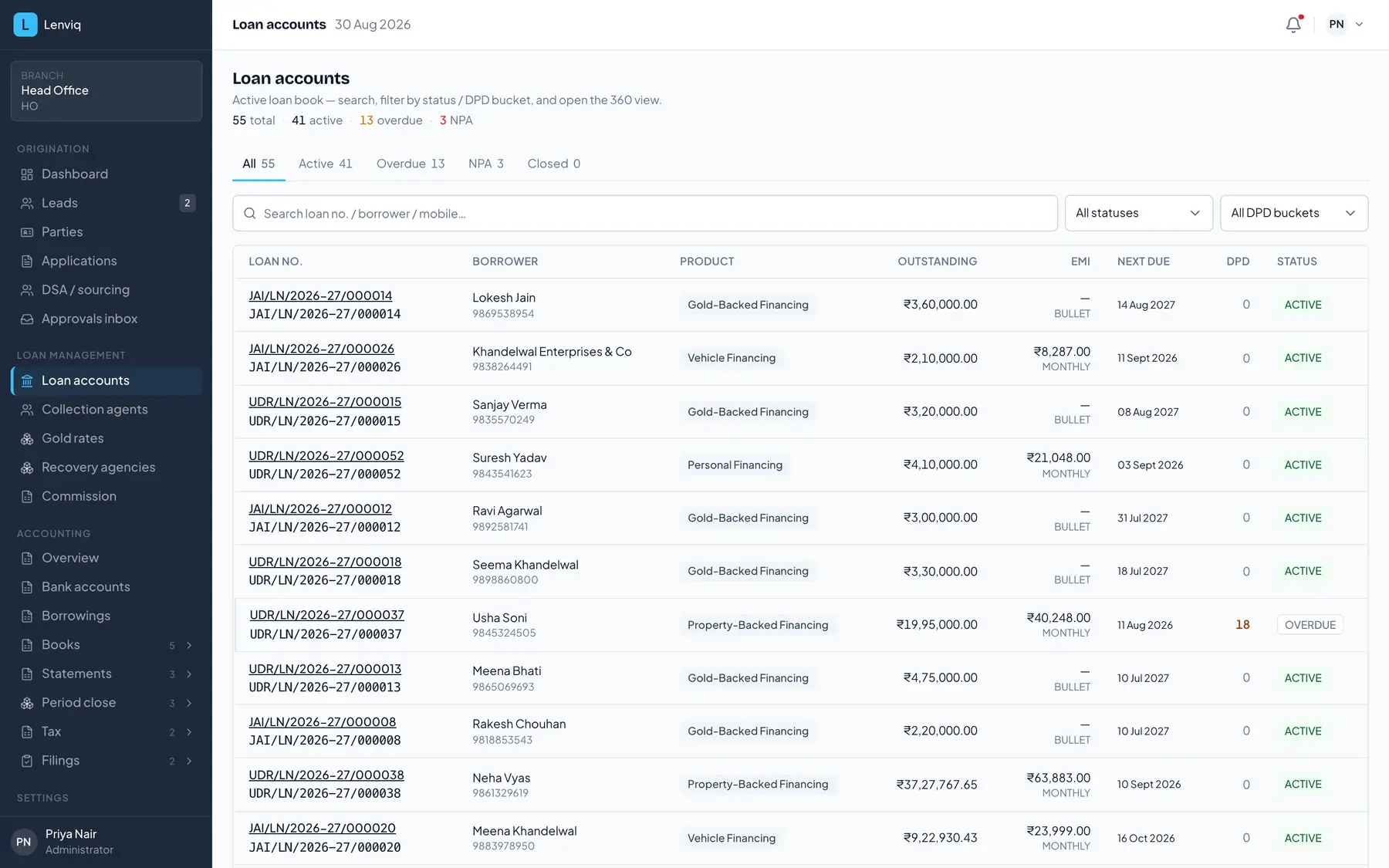
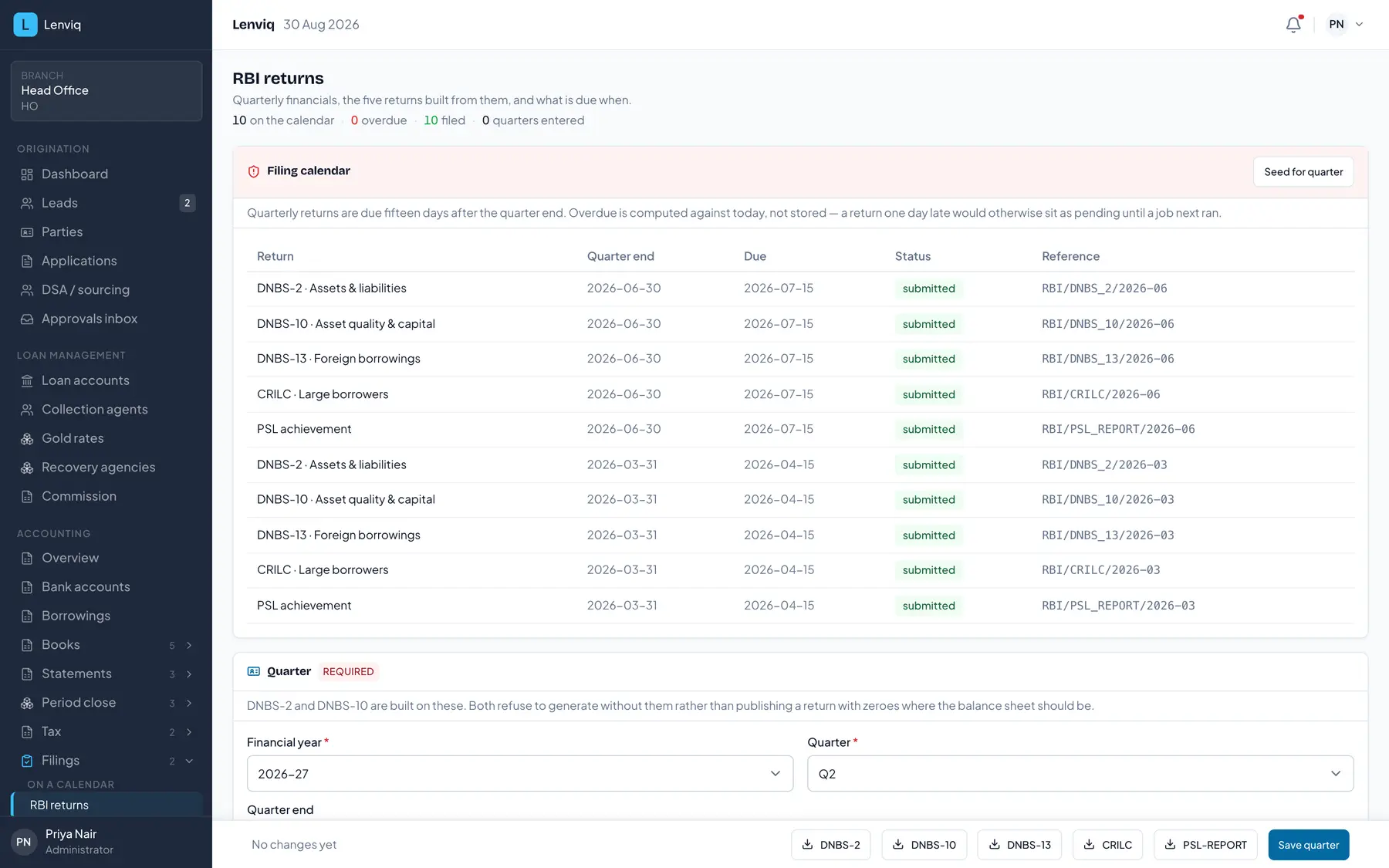
Every screen that shows a figure from a materialised view says when it was last rebuilt. A number with no timestamp invites the reader to treat it as live, which is how a stale figure ends up in a decision.
How the positions are held
Configured by you, enforced by the system, evidenced afterwards
A regulatory position is only worth as much as the record that it was applied. These are the three mechanisms every line above depends on.
Your policy, enforced as configured
Terms frozen at sanction
Every position dated to its direction
Software implements a position; it does not make a lender compliant. Nothing on this page is a legal opinion or an assurance that any filing will be accepted — your statutory auditor and your compliance officer remain the people who sign.
Questions
What a compliance head asks first
- Is Lenviq certified or approved by the RBI?
- No, and no lending software is. The Reserve Bank regulates lenders, not the software they buy. What a vendor can be held to is whether each position it implements matches the instrument it names, which is what this page is for.
- Does this make our NBFC compliant?
- It implements the positions above. Your board-approved policy, your scheme terms and the people who sign your returns are what make an NBFC compliant — a system can make the numbers right and can evidence how they were arrived at, and that is the part it is responsible for.
- What happens when a circular changes?
- The position changes with it and this page names the instrument that changed it — the penal charges row carries the December 2023 extension, and the credit information row carries the 2025 Directions that repealed the August 2024 circular. A page that quietly reworded itself would be worth less than one that says what moved.
- Can we see the classification a figure came from?
- Yes. Days past due, the classification it produced and the day it was computed on are held against the account, so a figure in a return can be opened back to the position it came from rather than recomputed and hoped to match.
- Which of these are configurable?
- The commercial choices — rate bands, charge amounts, penal grace, approval slabs. The regulatory positions are not: an SMA boundary or a ninety-day trigger that a tenant could move is a setting that produces a wrong return.
- Do you hold ISO 27001, SOC 2 or PCI DSS?
- No. The security page states what is and is not in place rather than implying a certification we do not hold.
Read the longer pieces
The blog goes into the two positions lenders most often get wrong — how the Key Facts Statement computes its APR, and what treating penal amounts as charges actually changes in the ledger.
Terms used above are defined in the glossary.